
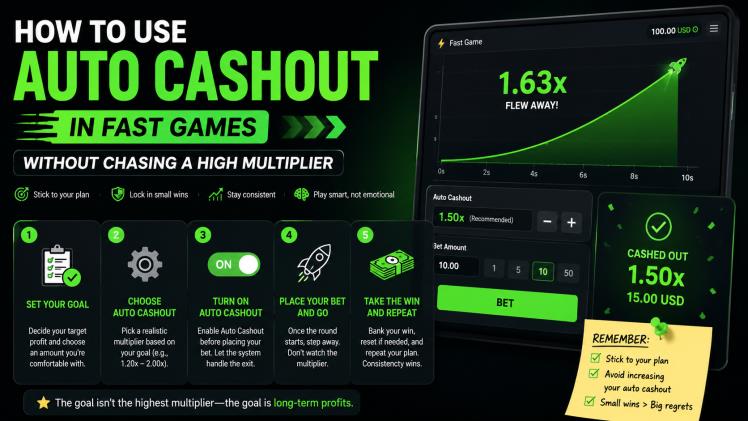

Fast games can make a player feel that one more round is enough to catch a bigger multiplier. The problem is speed: decisions repeat quickly, and the balance can change before the player has time to review the session. Auto cashout helps reduce this pressure because the exit point is set before the round starts. It turns a fast game from a reaction test into a controlled risk plan.
The main mistake is choosing auto cashout by the maximum multiplier shown on the screen. A target like x20 or x50 may look attractive, but it can require too many failed rounds before one hit appears. In fast formats, the safer question is different: how often does the chosen multiplier need to land to keep the session stable? A lower target can protect the bankroll better than a rare high payout.
Before using auto cashout, the player should connect the multiplier with stake size and session budget. If a game on Pinco KZ is played quickly, a fixed exit at x1.5 or x2 can be more practical than waiting for a dramatic number. The goal is not to catch the highest round. The goal is to avoid turning every miss into a reason to raise the next stake.
Why Auto Cashout Is Useful in Fast Games
Auto cashout removes one of the weakest moments in fast games: hesitation. When the multiplier is rising, the player can delay the exit for a few extra seconds and lose the whole stake. With auto cashout, the decision is made earlier. This does not guarantee profit, but it reduces impulsive changes during the round and keeps the plan consistent.
Speed increases turnover. If one round takes only a few seconds, even small stakes can create a large volume in 15-20 minutes. A $0.50 stake repeated 100 times already creates $50 in turnover. If the player keeps chasing higher multipliers after losses, the real exposure grows even faster. Auto cashout helps slow this pattern by fixing the target in advance.
What to Set Before the First Round
- Session budget: decide how much can be used today without adding extra deposits.
- Stake size: keep one round near 0.5-1% of the session budget for better control.
- Cashout target: choose a realistic multiplier, not the largest number seen in previous rounds.
- Stop limit: set a maximum number of rounds or a loss point before the game starts.
A low auto cashout target is not automatically weak. For example, x1.5 gives a smaller return, but it needs a shorter path than x10. This can suit players who want more controlled sessions and fewer large swings. A high target may fit only when the stake is very small and the player accepts long empty stretches. The multiplier should match the bankroll, not the mood of the session.
How to Choose the Right Multiplier
The useful approach is to divide targets into zones. A conservative range can sit around x1.3-x2, a balanced range around x2-x4, and a high-risk range above x5. These are not fixed rules, but they help structure decisions. The higher the target, the more failed rounds the bankroll must survive. If the session budget is small, the target should usually stay closer to the conservative range.
- Small bankroll: use lower targets and smaller stakes to increase the number of attempts.
- Medium bankroll: test balanced targets only after setting a strict stop-loss.
- High-risk plan: use higher multipliers only with a reduced stake size.
- After a win: do not raise the target automatically because one round went well.
The biggest danger is moving the auto cashout higher after seeing previous rounds reach big multipliers. Past rounds do not make the next round safer. If the player changes x2 to x8 only because the last result went high, the strategy becomes chasing. A fixed target is useful precisely because it blocks this kind of late adjustment.
Why Stake Size Matters More Than the Target
A high multiplier with a tiny stake can be safer than a low multiplier with an oversized stake. If the bankroll is $50 and the player uses $5 per round, only ten failed rounds can remove the full balance. With $0.50 stakes, the same bankroll gives far more room. Auto cashout works best when stake size is small enough to survive normal variance.
It is also important not to double the stake after a miss. This turns a fast game into a recovery system, and recovery systems can collapse quickly. A few failed rounds in a row can force the player into stakes that no longer match the original budget. Auto cashout should be paired with flat staking, otherwise the fixed exit target loses much of its value.
How to Avoid Chasing the Big Multiplier
Chasing usually starts when the player remembers the round that reached x30 and ignores the many rounds that ended much earlier. A big multiplier is visually memorable, but it may not be frequent enough to build a stable session around it. The better habit is to choose the cashout target before opening the game and keep it unchanged for a fixed block of rounds.
One practical method is to play in blocks. For example, use 20 rounds with the same stake and the same auto cashout target, then stop and review the balance. If the result is poor, reduce the stake or end the session instead of raising the multiplier. If the result is good, lock part of the profit rather than pushing the target higher.
Simple Risk Control for Fast Rounds
A fast game needs two limits: money and time. A player can stop after losing 30-40% of the session budget or after a fixed number of rounds. This prevents the game speed from creating too much turnover. If the budget is $50, a stop near $30-$35 keeps part of the balance for another session instead of letting one fast run decide everything.
Auto cashout should also be checked after any bonus or promo condition. If the game is used for wagering, the player must confirm whether the format counts, whether max bet rules apply and whether winnings are capped. A fast game with auto cashout can still be unsuitable for bonus play if it creates turnover too quickly or breaks promotion limits.
Conclusion
Auto cashout in fast games is useful because it fixes the exit point before emotion enters the round. To avoid chasing a high multiplier, choose a target that matches the bankroll, keep stake size small, play in blocks and stop before the session becomes a recovery attempt. A lower multiplier with discipline can be more practical than a rare high payout. The best result is not the biggest number on screen, but a game pace the player can control.







Leave a Comment